
Reading Moby Dick

In high school, my English literature class was assigned Herman Melville‘s Moby Dick. I found it the most boring book I’d ever read, and I ended up skimming large sections. It led to the only time I was ever sassy with my English teacher, whom I tormented in class by insisting that Jaws was a better book. This was not very nice of me, but in my defense, it’s unfair to assign a novel this long and this tedious to teenagers.
In the years since, I’ve occasionally challenged myself to read a famously difficult work of literature. Recently, I got the itch to read — really read, not skim — Moby Dick. I figured that in my present superannuated state, I would be more likely to appreciate its subtle charms than I did at the age of fifteen.
This turned out to be somewhat true, but I have to say, after reading all 650 pages of the deluxe Chiltern edition, that the thing really is pretty dull.
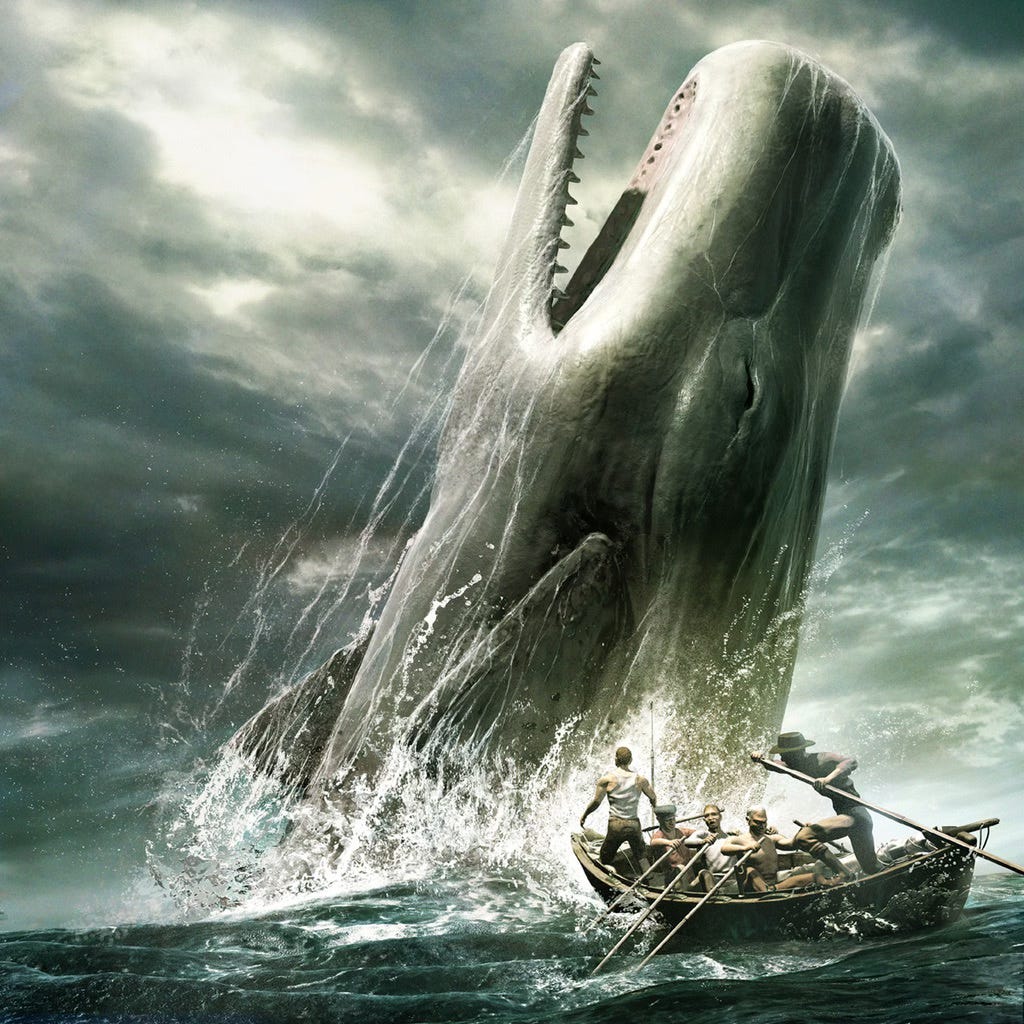
We begin with a lengthy, slow-paced, but generally interesting section in which our hero, who calls himself Ishmael, arrives at New Bedford in search of a berth on a whaling ship. Despite some seemingly pointless digressions, including a lengthy sermon about Jonah and the whale, these preliminaries are entertaining enough. There is a pretty strong narrative line, which pulls us along right up to the point when the Pequod, the whaling ship Ishmael has chosen, sets sale.
This, of course, is precisely the point when we expect the story to really take off. And it is at this point that Melville stops the story cold.
Instead of proceeding with the narrative, he presents us with a series of static descriptions of the major and minor characters on the ship, followed by the presentation of a typical meal at the captain’s table and a poetic rumination on the ship’s masthead, mixed with a great deal of material that I learned to call “encyclopedia entries”: throughout the book we are treated to discussions of the killing of whales, the butchering of whales, the taxonomy of whales, the prehistory of whales, the technology of whaling, the history of whaling, and pretty much anything else you can think of that involves, in any way, whales.
At first, I was genuinely baffled by this approach, and I found it hard to continue. At a certain point, however, I understood that Melville‘s intention was not to tell a story per se. The actual plot of Moby Dick is very thin and could be compressed to 150 pages or less. Instead, the book is meant to be a kind of catchall of story elements, miscellaneous facts, philosophical speculations, and literary experiments. It is not meant to be realistic; the unlettered sailors are made to deliver Shakespearean monologues, the symbolism is unsubtle, and Captain Ahab’s mad quest becomes increasingly theatrical and surreal as the book chugs toward its climax. Instead of asking, “What happens next?“, the reader is expected to sample each new tidbit in this miscellany as a separate tasting in an ever-varied menu. The reason for the stoppage of the plot as soon as the voyage gets underway is to emphasize that the plot is not important.
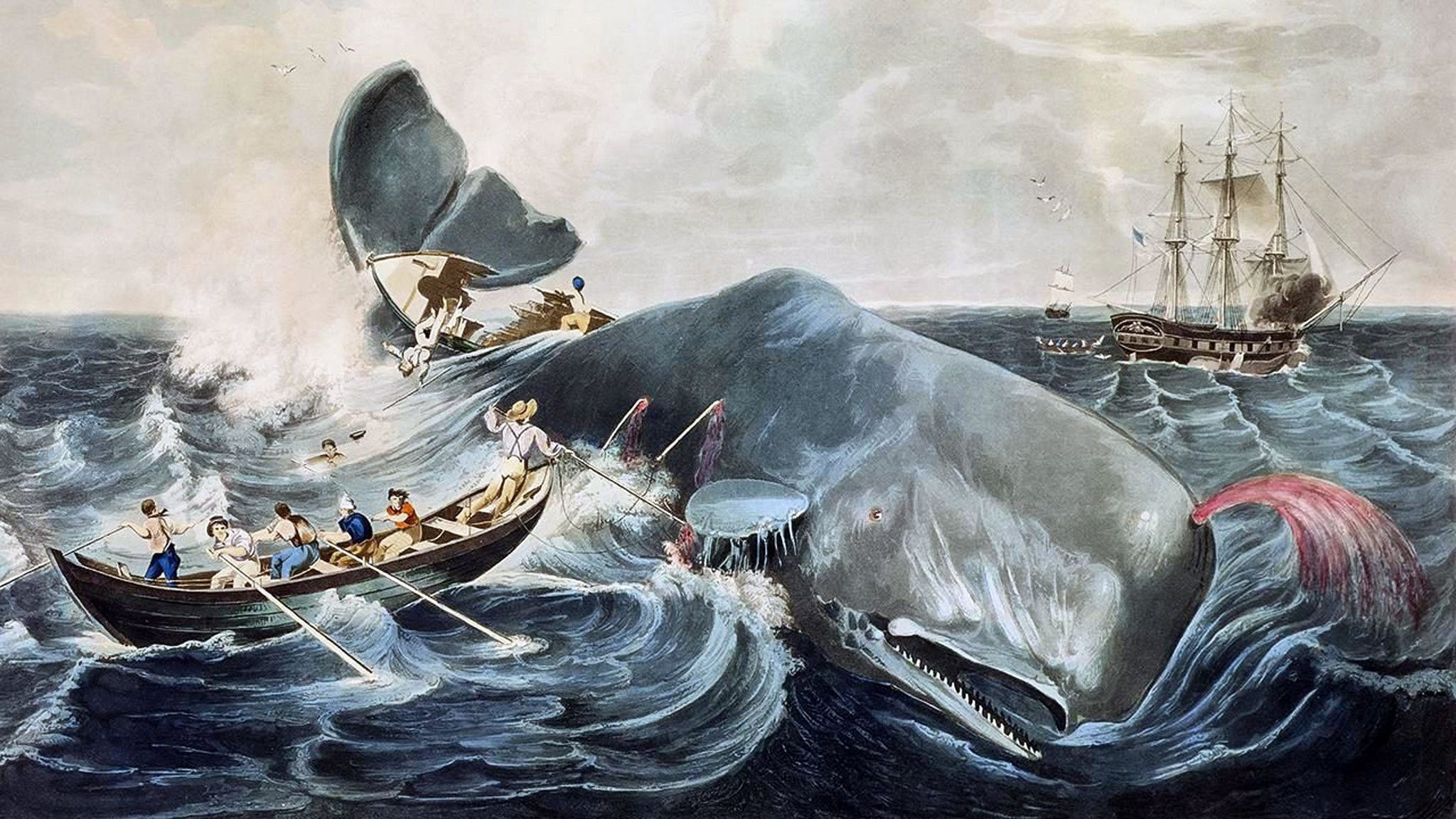
Taken in this way, the book became readable again. But by the time I was two-thirds through, my interest was waning. I was reduced to the expedient of reading a minimum of ten pages a day and keeping track of how far I’d gotten percentage-wise and how far I had left to go. In other words, the 650 page novel had become a long, dull slog — precisely how I remembered it from high school. And while Jaws is not a better book (it is, in fact, a pretty lousy one), it certainly works harder to hold your interest.
That’s not to say Moby Dick is without its good points. Melville was a master of vital, you-are-there descriptions, which make the whaling scenes in particular come alive. Here is part of his narrative of the first whale hunt, when the small boats have been lowered and are giving chase.
It was a sight full of quick wonder and awe! The vast swells of the omnipotent sea; the surging, hollow roar they made, as they rolled along the eight gunwales, like gigantic bowls in a boundless bowling-green; the brief suspended agony of the boat, as it would tip for an instant on the knife-like edge of the sharper waves, that almost seemed threatening to cut it in two; the sudden profound dip into the watery glens and hollows; the keen spurrings and goadings to gain the top of the opposite hill; the headlong, sled-like slide down its other side; — all these, with the cries of the headsmen and the harpooneers, and the shuddering gasps of the oarsmen, with the wondrous sight of the ivory Pequod bearing down upon her boats with outstretched sails, like a wild hen after her screaming brood; — all this was thrilling.
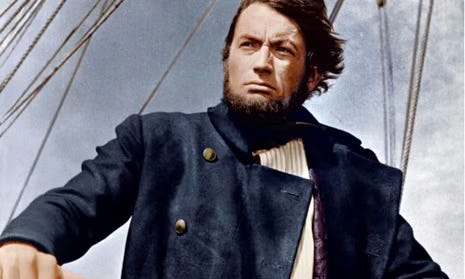
The doomed, monomaniacal captain Ahab remains one of the most iconic figures in literature. The various foreign-born characters are depicted with friendliness and respect. Melville, who lived with cannibals for a time during his own nautical career, sees no inherent inferiority in alien customs and beliefs; if anything, he seems more cynical about the orthodox beliefs of his own culture.
The book teaches you everything you could want to know about the mid-19th century whaling business — and probably a great deal more. And I was sufficiently interested in what I learned to do a little bit of outside research.
I learned that there was a real-life Moby Dick by the name of Mocha Dick, an albino sperm whale known for his aggressiveness and cunning, who terrorized whalers in the 1830s. His story clearly inspired Melville's creation. Mocha Dick was killed in 1838, but his fictional counterpart is more fortunate. Moby Dick survives his run-in with Ahab. He simply swims away after dragging his nemesis into the deep.
The name Moby does not seem to have any particular meaning; it is not found in dictionaries of the period. Maybe Melville just liked how it sounded.
Ahab was named after an evil king from the Bible — the husband of the infamous Jezebel, and a notorious blasphemer in his own right. The biblical Ishmael was a wanderer, just as our narrator is. The ill-fated Pequod was named after the Pequot Indians, a tribe decimated by pestilence and war.
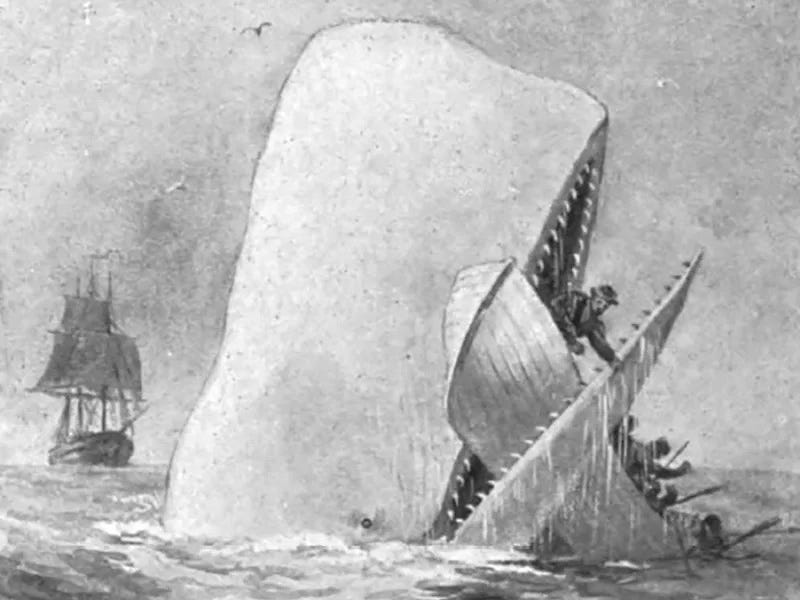
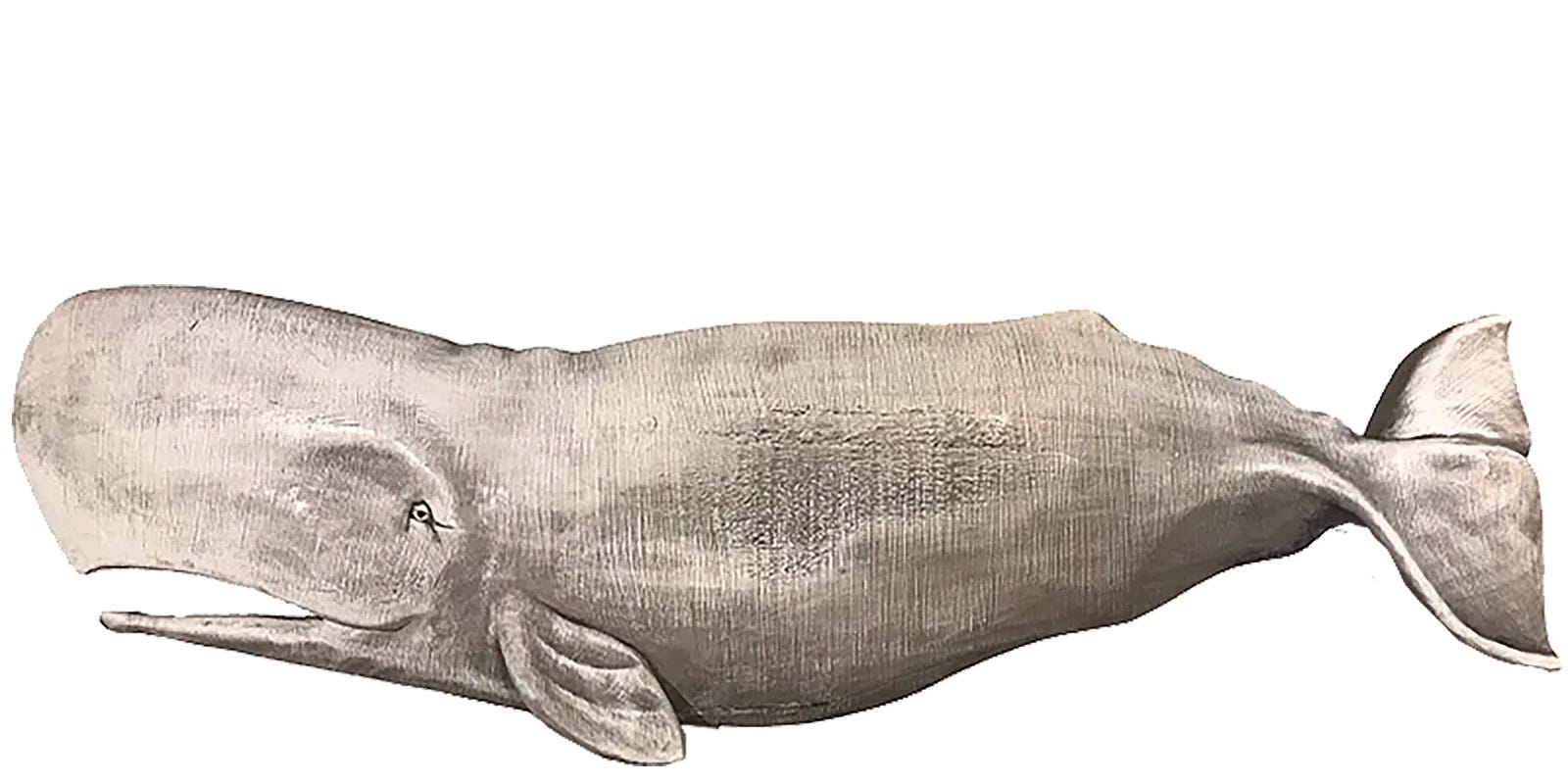
I wondered why the blue whale, which is considerably larger than the sperm whale of the title, goes unmentioned in the book. It turns out that while the blue whale had long been known in a vague way to science, it was altogether unknown to whalers, who had never hunted it. Like Melville, they were under the impression that the sperm whale was the largest species. The sperm whale, by the way, is an ungainly beast with a huge blocky head like a battering ram. He looks kind of goofy to me, though I doubt I that impression would hold up if he were bearing down on me on the high seas.
And oh, yes, there’s the hyphen. The title page of the first edition of the book, and of many editions that followed, hyphenated the name Moby Dick. Nobody knows why. The name is not hyphenated in the text itself.
Overall, I’m glad I came back to Moby Dick and gave it another try. But would I read it again?
Maybe in another fifty years …
I'm very proud of your dedication to escaping reality. What else can we do really?
I recently read Jules Vernes with many expectations but did not like it "that much"; it was "Captain Hatteras", but I have to admit that there is ONE passage which was still exceptionnal^^^
Thank you for your appreciation of Moby Dick; I had a look at the book shop you've linked and I found the editions beautiful. Happy readings!